Blog

  1. My latest book is now published! Cemeteries & Graveyards. A Guide for Local & Family Historians
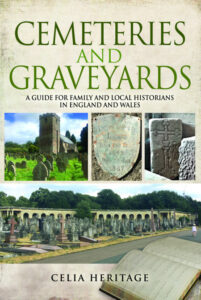
    My latest book, Cemeteries & Graveyards, a Guide for Local and Family Historians is very special; the gestation was long for numerous reasons. It encompassed a global pandemic and a set of very challenging events in my own life about which I will blog in due course – so watch this space and sign up to follow my blog! But – finally after 5 years it is here – and I hope it will push boundaries for family and local historians respectively and promote a deeper understanding of our burial history and cemeteries and graveyards too – and also help you track down those missing burials.

    You can order your copy direct from the publisher Pen & Sword books ( or via Amazon although delivery is likely to be slower) and read my Pen and Sword blog post at https://www.pen-and-sword.co.uk/blog/celia-looks-at-understanding-our-deeper-roots-in-the-context-of-cemeteries-and-graveyards/.

    Check back shortly for my first personal blog on the circumstances surrounding the writing of my latest book and why it means so much to me.

  2. Until the late nineteenth century the cost of erecting a gravestone over the burial place of a family member was beyond the means of many of our poorer ancestors. Those who could afford it, however, would no doubt have hoped that the memorial would last for many years after its erection. Sadly, as most family historians realise, this was often not the case. While headstones deteriorate at varying rates depending on climate conditions and the type of stone, a large number have also been moved during alterations to the church or churchyard. Some memorials have been re-sited but some, unfortunately, were not and have been destroyed. Therefore, even if you find a memorial to an ancestor don’t presume that he or she must actually lie beneath.

    The burial sites of our ancestors might also have been disturbed by later burials, while both the church and churchyard were places where social status played an important part. There are examples of individuals arranging for the occupants of family burial vaults within the church to be  re-interred outside in the churchyard so that they themselves could take over the more prized location within the church after their own death.

    Even in the churchyard there are examples of what can best be described as the inconsiderate siting of memorial stones, these being placed where they all but obscure earlier gravestones. A good case is to be found at Brookland Church, Romney Marsh, Kent. Here a large body tomb dated 1852 in memory of  Ellen the wife of Clifton Simmonds has been rudely placed so that it backs right on to the front of an earlier gravestone to  Robert Skeere and his wife Mary, erected approximately 50 years earlier. Somewhat galling for the Skeere family!

    The gravestone of Ellen wife of Clifton Simmonds, Brookland

    In the churchyard the families of the deceased often showed little care or sensitivity for those buried before. Here the large body tomb of Ellen Simmonds backs directly on to the face of the earlier memorial to Mary and Robert Skeere, totally dominating and obstructing the earlier stone

    Brookland Kent. Memorial to Mary & Robert Skeere rudely crowded out by the later gravestone to Ellen Simmonds 1852